
Short description
The calculation settings are the basis for all Profit, Margin and ROI calculations in ArbitrageOne. Here you define which fees, tax rules and thresholds are applied to every deal.Requirements
- Clarity about your Amazon fee structure
- Your VAT model (standard rate, not registered, small business …)
Step-by-step guide
Step 1: Open the calculation page
→ Open directly in the app: app.arbitrageone.de/settings/calculation Navigate to Settings → Calculation. The page is split into several sections: Calculation (with thresholds), Tax settings, Max Cost and Fees.
Step 2: Choose the calculation basis
Under Calculation you select:- ROI basis: Net or gross purchase price — determines what your ROI is calculated against.
- Average price: Which reference price (e.g. 30/60/90/180-day average) is used by default for the calculation.

Step 3: Configure taxes
Under Tax settings you choose your tax registration:- Standard taxation / Standard Rate
- Not registered (e.g. small business)
- Not applicable
- Flat (with additional percentage field)

Step 4: Define thresholds for good deals
Within the calculation card you define two tiers under Thresholds (Medium and Good) for ROI %, Margin % and Profit (€). ArbitrageOne colour-codes deals in the sheet accordingly.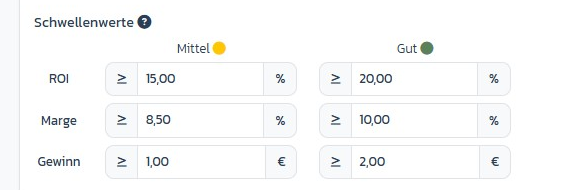
Step 5: Define Max Cost
Max Cost is the maximum cost per unit at which a deal is still worthwhile. Enter the three minimum values (Minimum ROI, Minimum Margin, Minimum Profit) and choose via radio button whether all criteria (AND) or at least one (OR) must be met. Values of 0 are ignored.
Step 6: Enter fees
In the Fees section you add:- Other fees per unit net: Flat extra costs per unit (e.g. labeling)
- Other fees per unit in percent: Percentage surcharge (e.g. payment processor)
- Default FBM fee net: Default shipping cost for FBM listings
💡 Note from the UI: Prep fees are not entered here but in the shipping addresses. In sourcing, the prep fees of the default shipping address are applied.

Step 7: Cost of Goods (optional)
On the separate Purchase prices page (inside ProfitTracker) you store fixed CoG values per SKU or ASIN — useful for private label or constant purchase prices.Important notes
- Changes apply retroactively to the display of all existing deals, but not to historical purchases in ProfitTracker.
- The Max Cost logic is also used in the Sourcing Mastersheet and in FlipHunter.